

WeGreened Approval Statistics: Week of February 16, 2026
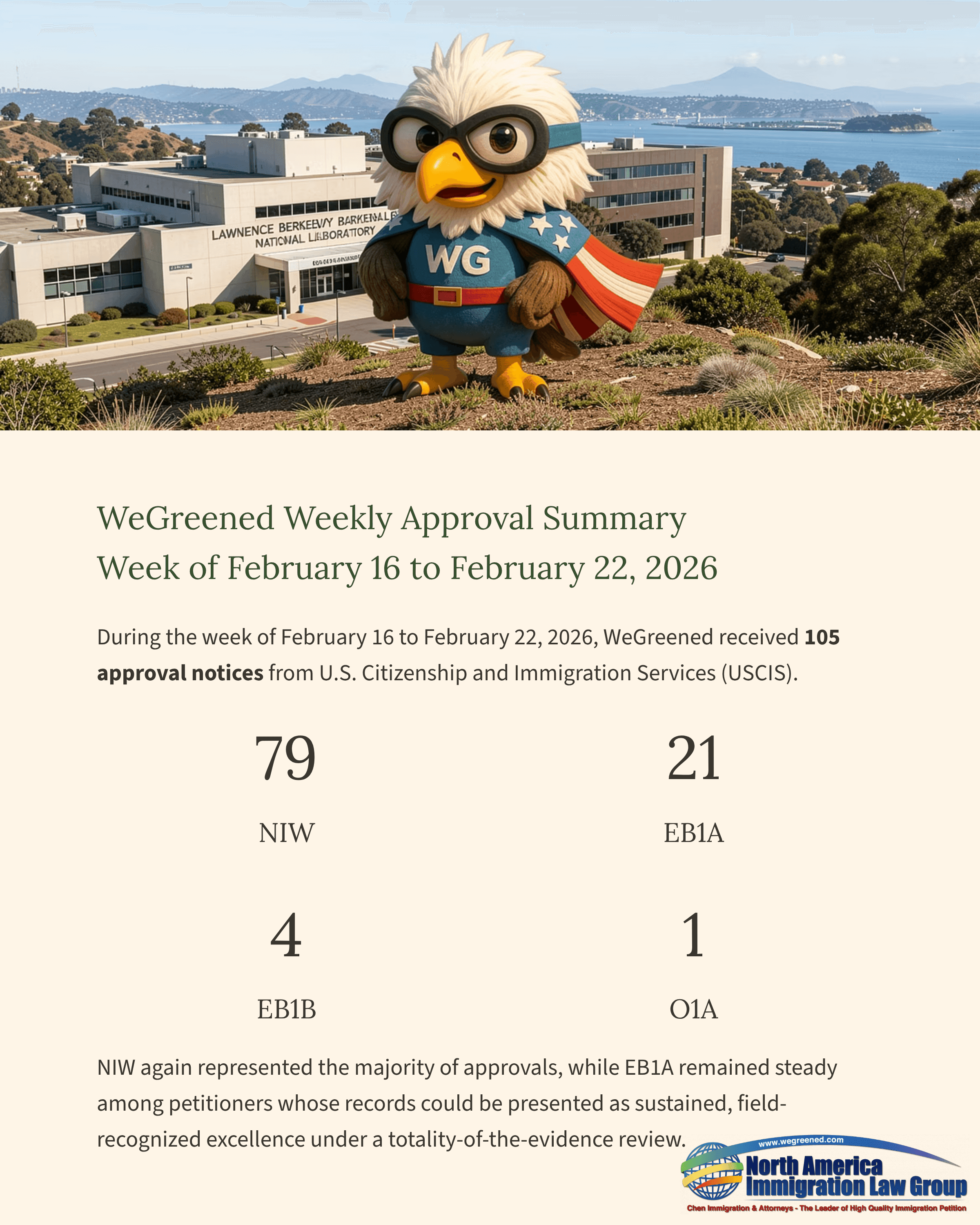
During the week of February 16 to February 22, 2026, WeGreened received 105 approval notices from U.S. Citizenship and Immigration Services (USCIS). Of the 105 approvals, 79 were for NIW (National Interest Waiver), 21 for EB1A (Alien of Extraordinary Ability), 4 for EB1B (Outstanding Professors or Researchers), and 1 for O1A (Individuals with Extraordinary Ability or Achievement).
NIW again represented the majority of approvals, while EB1A remained steady among petitioners whose records could be presented as sustained, field-recognized excellence under a totality-of-the-evidence review.
EB1A and NIW Credential Analysis
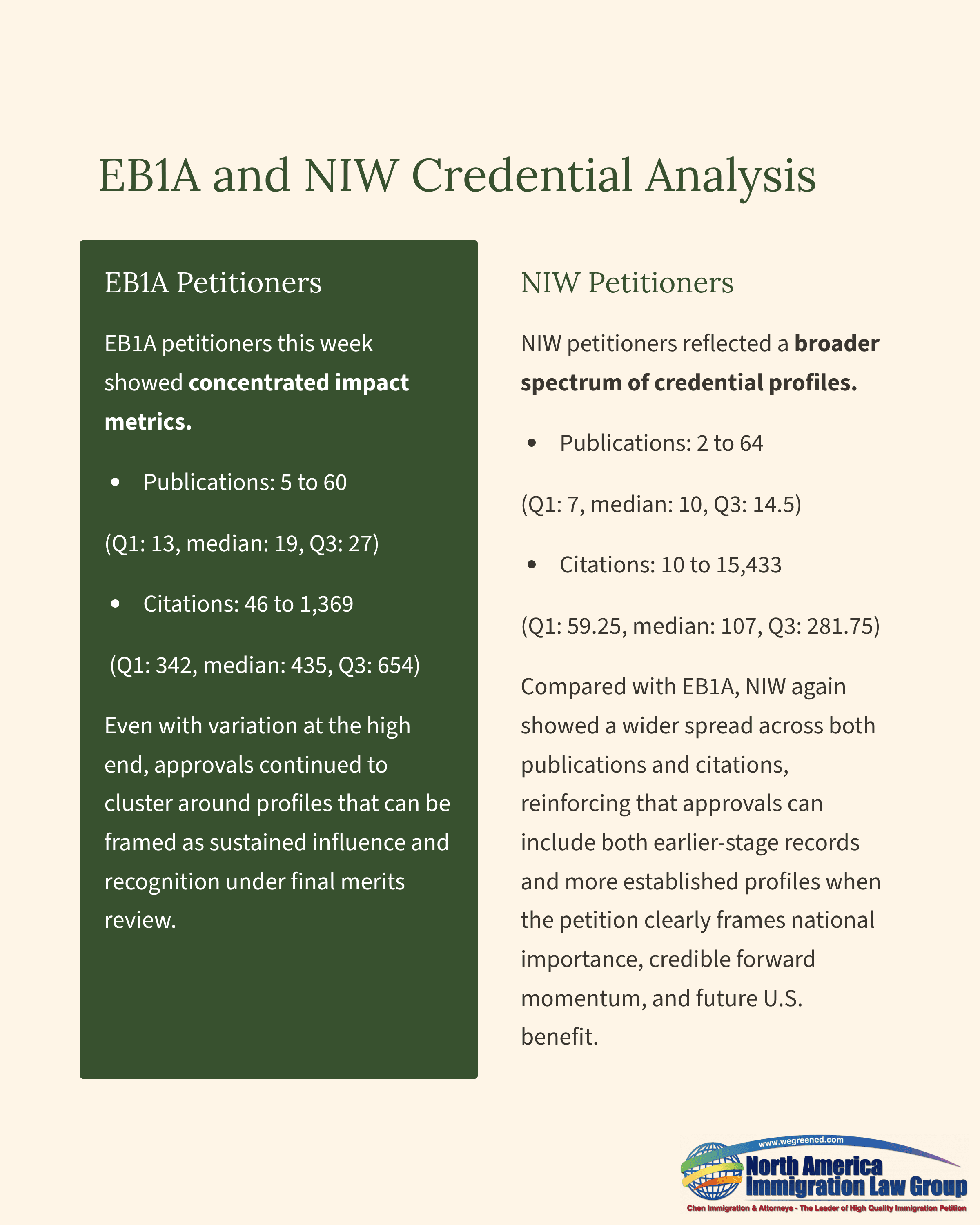
EB1A petitioners this week showed concentrated impact metrics. Publications ranged from 5 to 60 (Q1: 13, median: 19, Q3: 27), and citations ranged from 46 to 1,369 (Q1: 342, median: 435, Q3: 654). Even with variation at the high end, approvals continued to cluster around profiles that can be framed as sustained influence and recognition under final merits review.NIW petitioners reflected a broader spectrum of credential profiles. Publications ranged from 2 to 64 (Q1: 7, median: 10, Q3: 14.5), and citations ranged from 10 to 15,433 (Q1: 59.25, median: 107, Q3: 281.75). Compared with EB1A, NIW again showed a wider spread across both publications and citations, reinforcing that approvals can include both earlier-stage records and more established profiles when the petition clearly frames national importance, credible forward momentum, and future U.S. benefit.
Insights on Petitioner Backgrounds and Fields
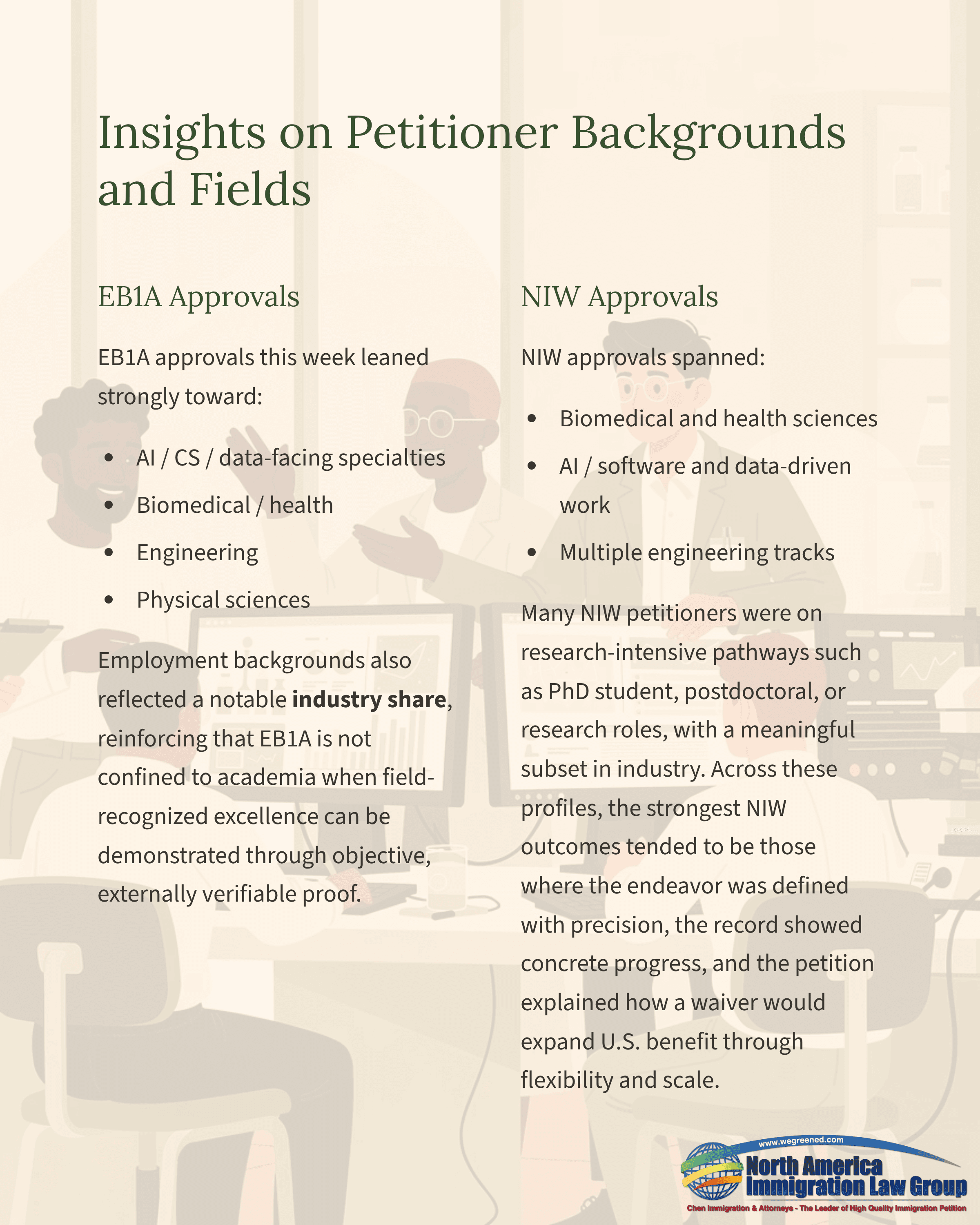
EB1A approvals this week leaned strongly toward AI/CS/data-facing specialties, alongside biomedical/health, engineering, and physical sciences. Employment backgrounds also reflected a notable industry share, reinforcing that EB1A is not confined to academia when field-recognized excellence can be demonstrated through objective, externally verifiable proof.NIW approvals spanned biomedical and health sciences, AI/software and data-driven work, and multiple engineering tracks. Many NIW petitioners were on research-intensive pathways such as PhD student, postdoctoral, or research roles, with a meaningful subset in industry. Across these profiles, the strongest NIW outcomes tended to be those where the endeavor was defined with precision, the record showed concrete progress, and the petition explained how a waiver would expand U.S. benefit through flexibility and scale.
Highlighted EB1A Case: Industry AI and Optimization Leader Approved with 46 Citations
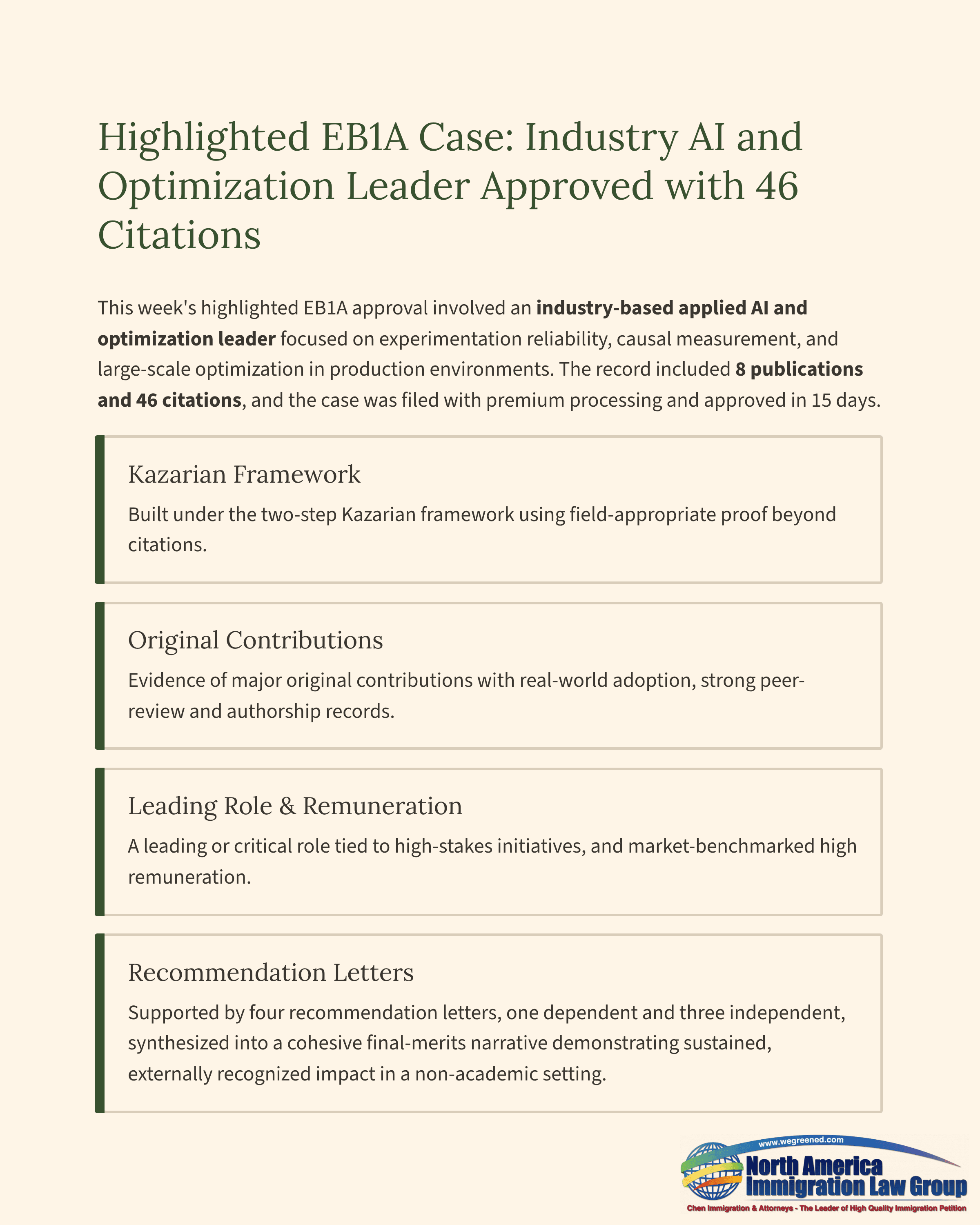
One notable EB1A approval this week involved an industry-based applied AI and optimization leader whose work centered on large-scale experimentation reliability, causal measurement, and network-level optimization in high-impact production environments. The record included 8 publications and 46 citations, and the case was filed with premium processing and approved in 15 days.Strategically, we organized the filing under the two-part Kazarian framework and built the petition around field-appropriate evidence that USCIS officers can evaluate clearly even when academic metrics are not the core story. For the original contributions prong, we framed a production-deployed, reliability-focused experimentation framework as a major industry contribution, supported by objective indicators of adoption and corroborating documentation. We strengthened the judging criterion with a substantial peer-review record, supported scholarly authorship through publications in selective venues, and reinforced the leading/critical role element by tying responsibility to high-stakes, large-scale initiatives. We also supported the high salary criterion with market benchmarking evidence.
Third-party validation was a key lever in this filing. Our firm drafted four recommendation letters, including one dependent recommender and three independent recommenders, designed to establish field context, validate the technical significance of the work, and reinforce why the overall record supports EB1A under final merits. We then consolidated these elements into a cohesive narrative emphasizing sustained, externally recognizable impact and trusted field standing in an applied, non-academic setting.
This case reinforces that EB1A can succeed for industry-forward profiles when the petition selects the strongest objective indicators of field trust and organizes them into a clear criterion-by-criterion record with a persuasive final-merits synthesis.
Adjudication Trends and Policy Observations
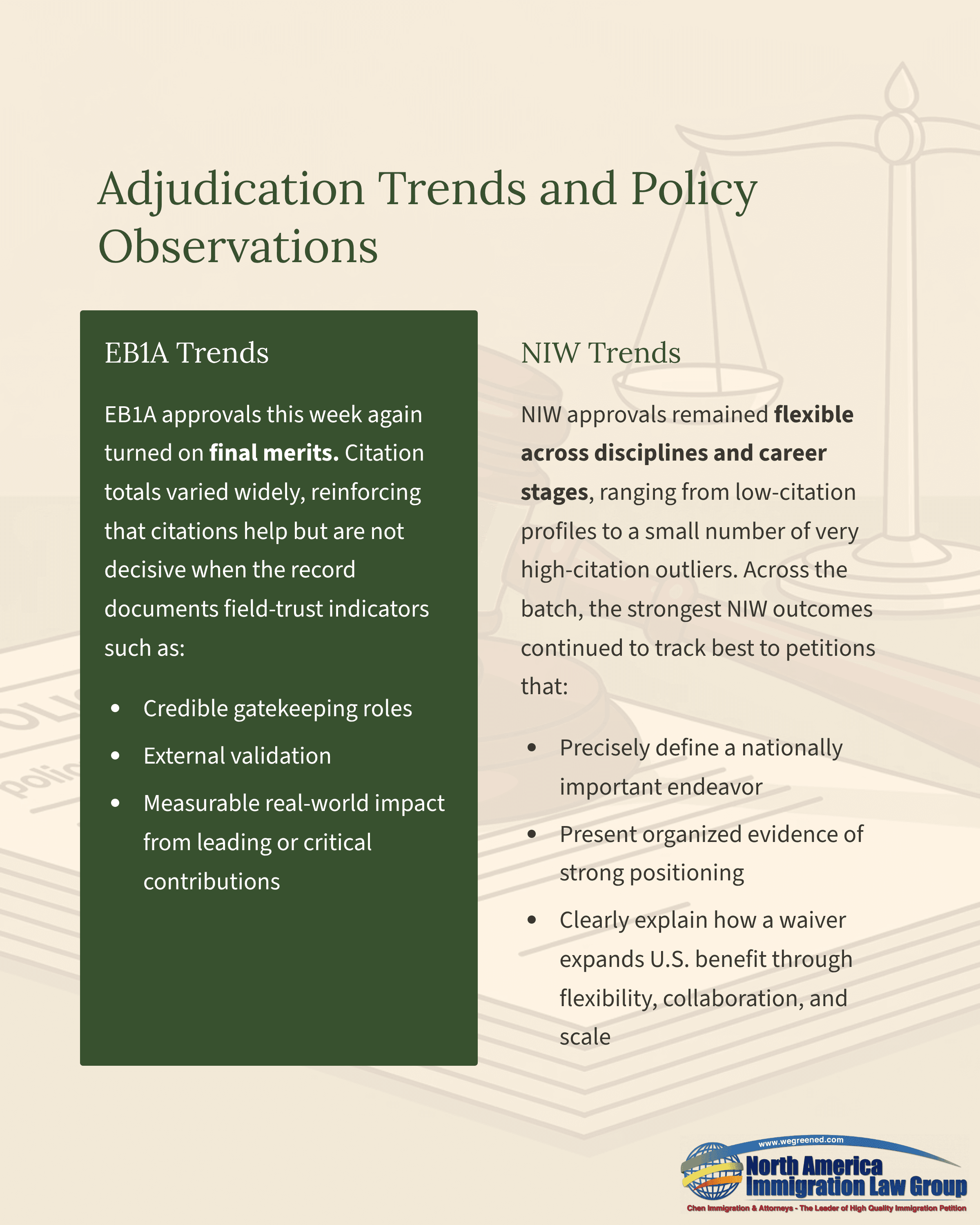
EB1A approvals this week again hinged on a compelling final merits showing. Citation totals varied substantially, and this dataset included an EB1A approval at the lowest citation end of the week’s EB1A range, reinforcing that citations can be helpful but not determinative when the record clearly documents field-trust indicators such as credible gatekeeping roles, external validation, and leading/critical contributions with measurable real-world significance.NIW approvals continued to reflect broad flexibility across disciplines and career stages, spanning from the low end of citations through one extreme high-citation outlier at the top end. Across the batch, the consistent throughline remained unchanged: the strongest NIW outcomes tracked best to petitions that precisely define a nationally important endeavor, present organized and concrete evidence showing the petitioner is well positioned, and clearly explain how a waiver expands U.S. benefit through flexibility, collaboration, and scale.