
WeGreened Approval Statistics: Week of February 23, 2026
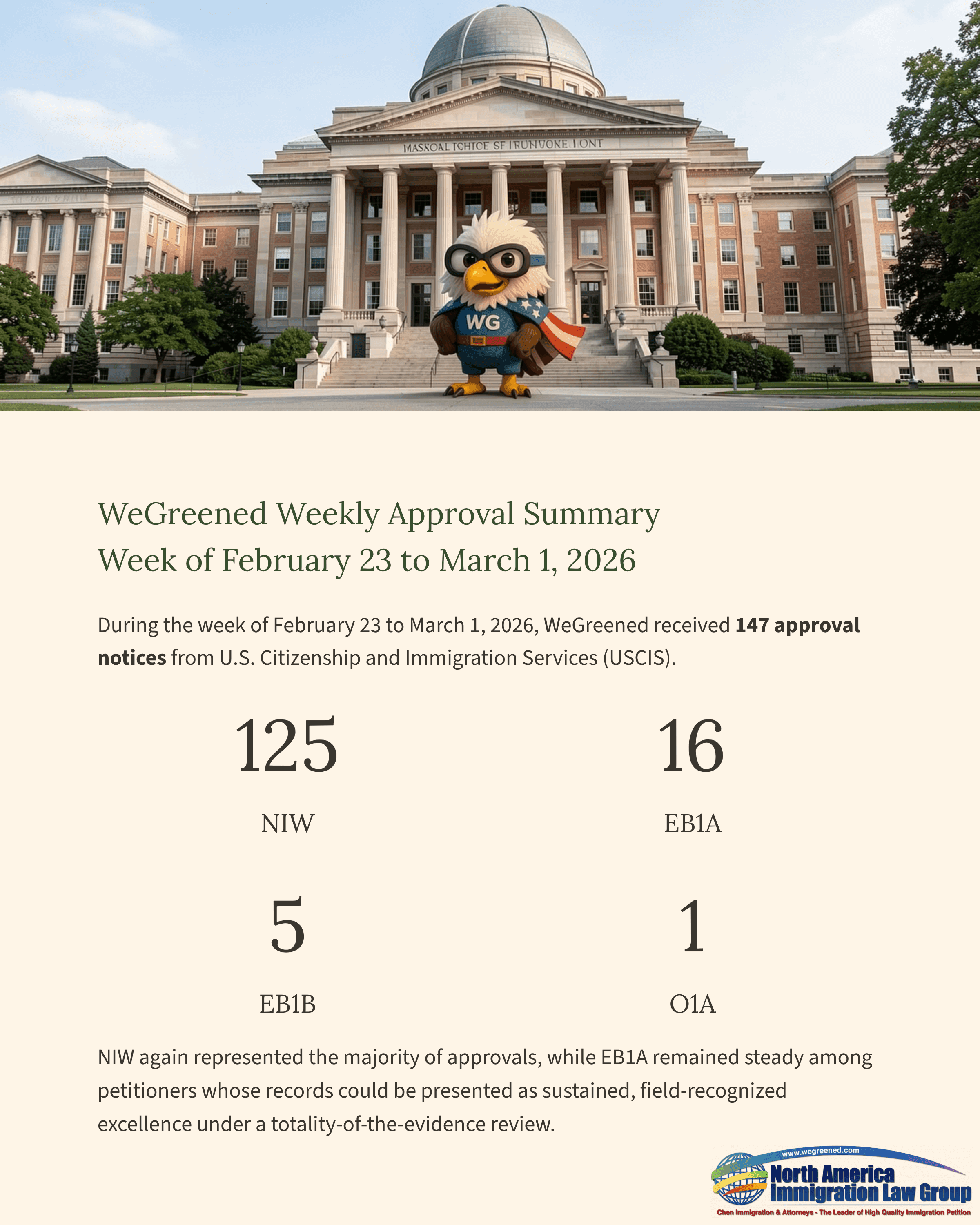
During the week of February 23 to March 1, 2026, WeGreened received 147 approval notices from U.S. Citizenship and Immigration Services (USCIS). Of the 147 approvals, 125 were for NIW (National Interest Waiver), 16 for EB1A (Alien of Extraordinary Ability), 5 for EB1B (Outstanding Professors or Researchers), and 1 for O1A (Individuals with Extraordinary Ability or Achievement).
NIW again represented the majority of approvals, while EB1A remained steady among petitioners whose records could be presented as sustained, field-recognized excellence under a totality-of-the-evidence review.
EB1A and NIW Credential Analysis
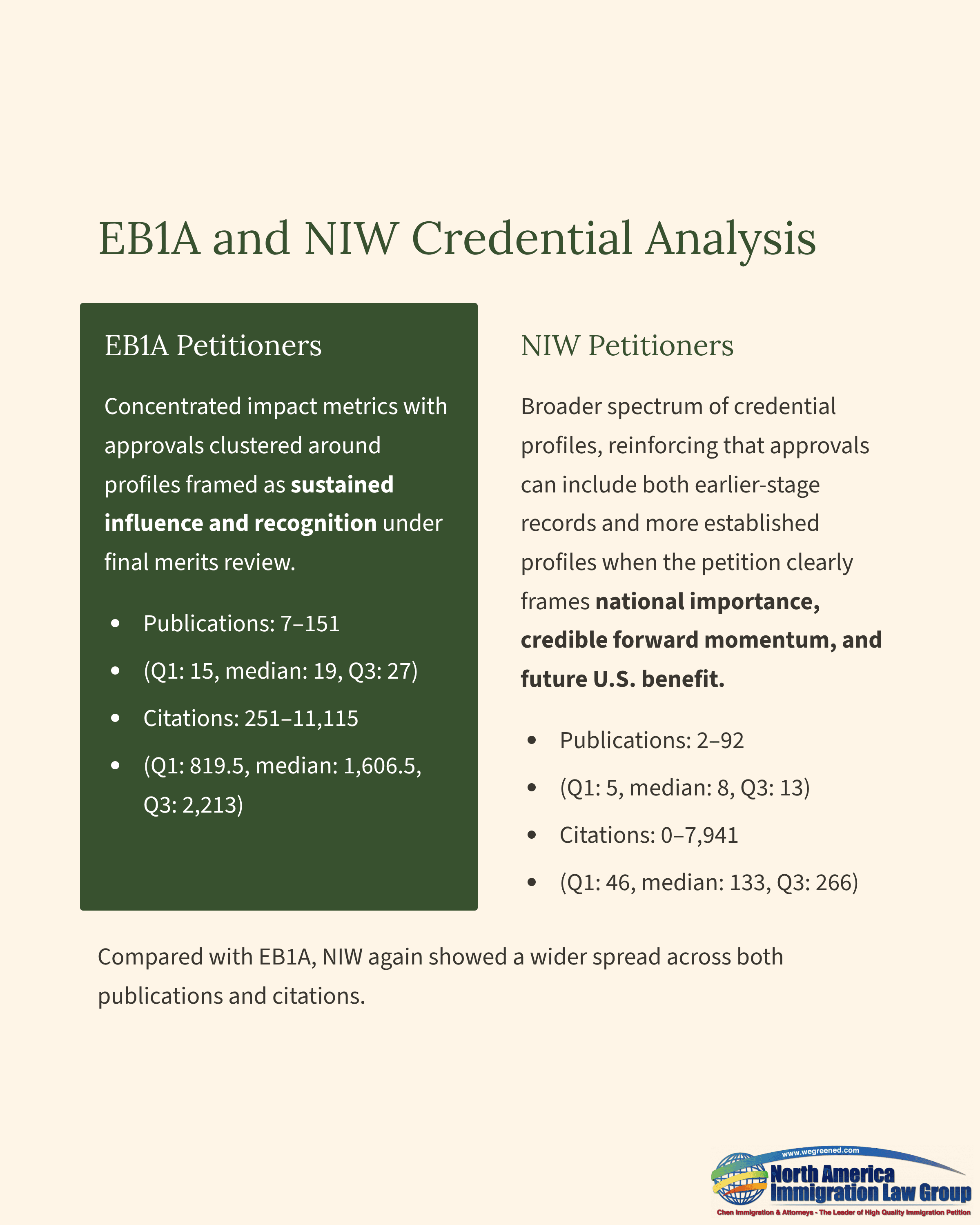
EB1A petitioners this week showed concentrated impact metrics. Publications ranged from 7 to 151 (Q1: 15, median: 19, Q3: 27), and citations ranged from 251 to 11,115 (Q1: 819.5, median: 1,606.5, Q3: 2,213). Even with high-end variation, approvals clustered around profiles that could be framed as sustained influence and recognition under final merits review.NIW petitioners reflected a broader spectrum of credential profiles. Publications ranged from 2 to 92 (Q1: 5, median: 8, Q3: 13), and citations ranged from 0 to 7,941 (Q1: 46, median: 133, Q3: 266). Compared with EB1A, NIW again showed a wider spread across both publications and citations, reinforcing that approvals can include both earlier-stage records and more established profiles when the petition clearly frames national importance, credible forward momentum, and future U.S. benefit.
Insights on Petitioner Backgrounds and Fields
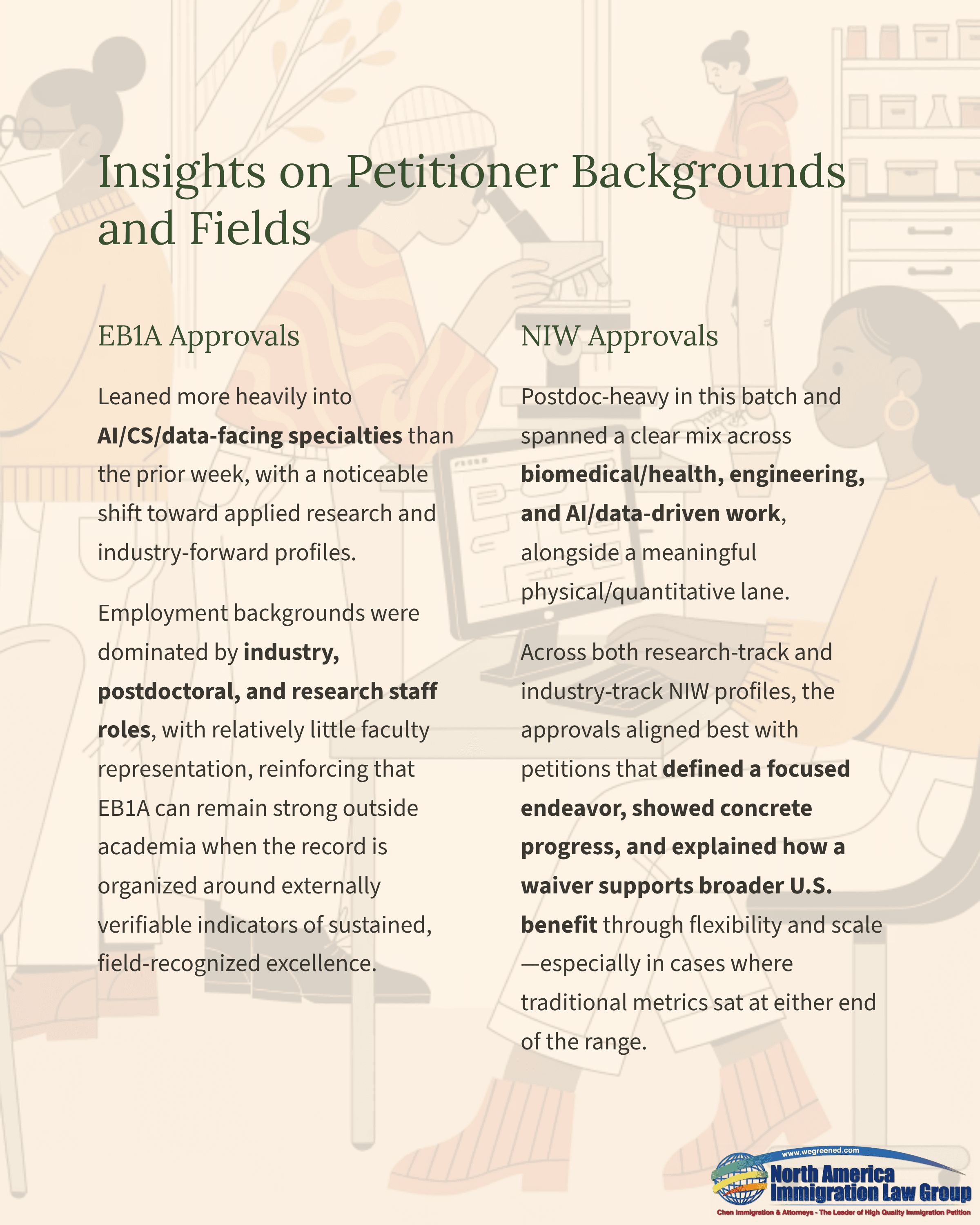
EB1A approvals this week leaned more heavily into AI/CS/data-facing specialties than the prior week, with a noticeable shift toward applied research and industry-forward profiles. Employment backgrounds were dominated by industry, postdoctoral, and research staff roles, with relatively little faculty representation, reinforcing that EB1A can remain strong outside academia when the record is organized around externally verifiable indicators of sustained, field-recognized excellence.NIW approvals were postdoc-heavy in this batch and spanned a clear mix across biomedical/health, engineering, and AI/data-driven work, alongside a meaningful physical/quantitative lane. Across both research-track and industry-track NIW profiles, the approvals aligned best with petitions that defined a focused endeavor, showed concrete progress, and explained how a waiver supports broader U.S. benefit through flexibility and scale, especially in cases where traditional metrics sat at either end of the range.
Highlighted NIW Case: NIW Approved at the Zero-Citation End for a Renal Pathophysiology PhD Student
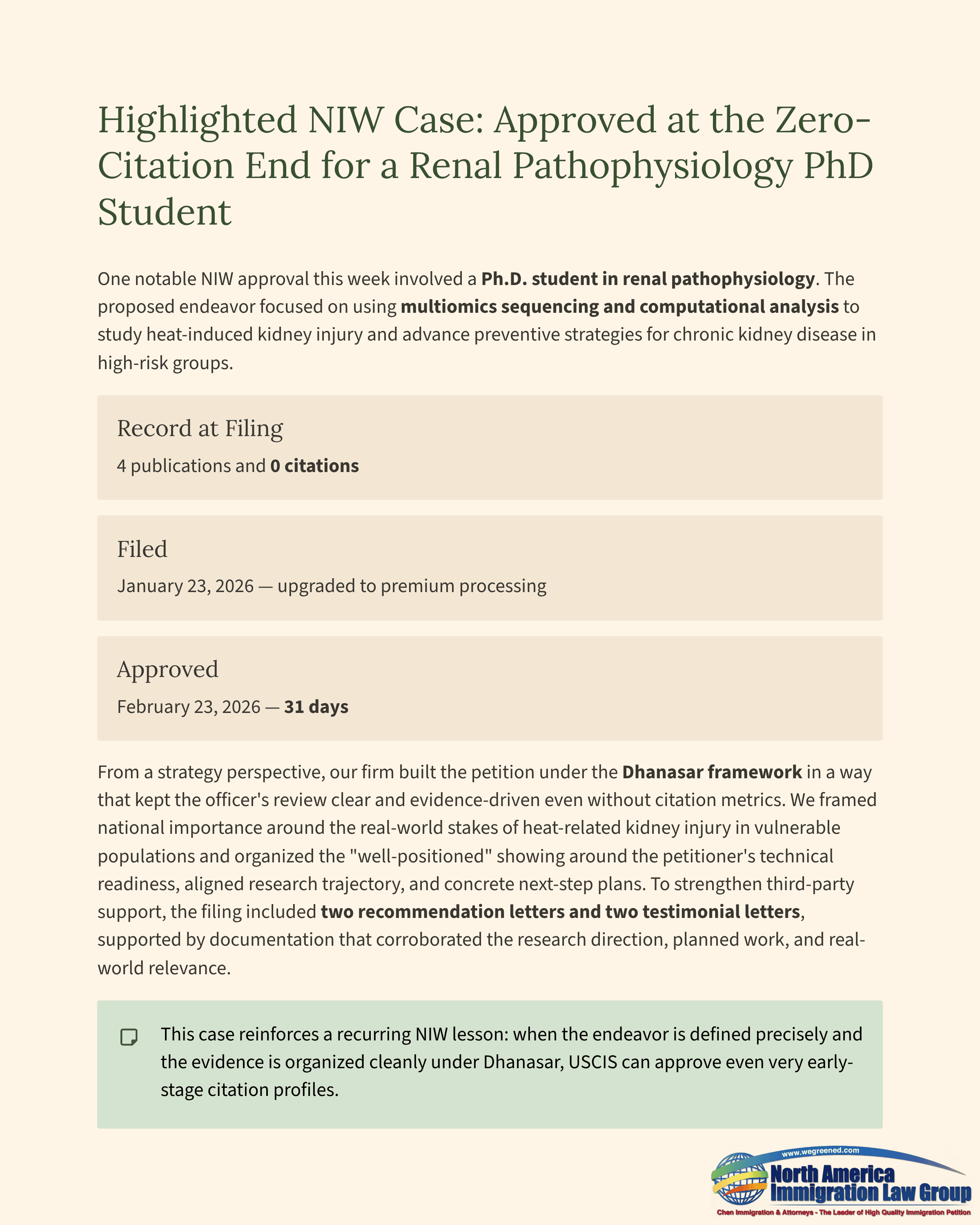
One notable NIW approval this week involved a Ph.D. student in renal pathophysiology. The proposed endeavor focused on using multiomics sequencing and computational analysis to study heat-induced kidney injury and advance preventive strategies for chronic kidney disease in high-risk groups. At the time of filing, the record included 4 publications and 0 citations. The case was filed on January 23, 2026, upgraded to premium processing, and approved on February 23, 2026 (31 days).From a strategy perspective, our firm built the petition under the Dhanasar framework in a way that kept the officer’s review clear and evidence-driven even without citation metrics. We framed national importance around the real-world stakes of heat-related kidney injury in vulnerable populations and organized the “well-positioned” showing around the petitioner’s technical readiness, aligned research trajectory, and concrete next-step plans. To strengthen third-party support, the filing included two recommendation letters and two testimonial letters, supported by documentation that corroborated the research direction, planned work, and real-world relevance.
This case reinforces a recurring NIW lesson: when the endeavor is defined precisely and the evidence is organized cleanly under Dhanasar, USCIS can approve even very early-stage citation profiles.
Adjudication Trends and Policy Observations
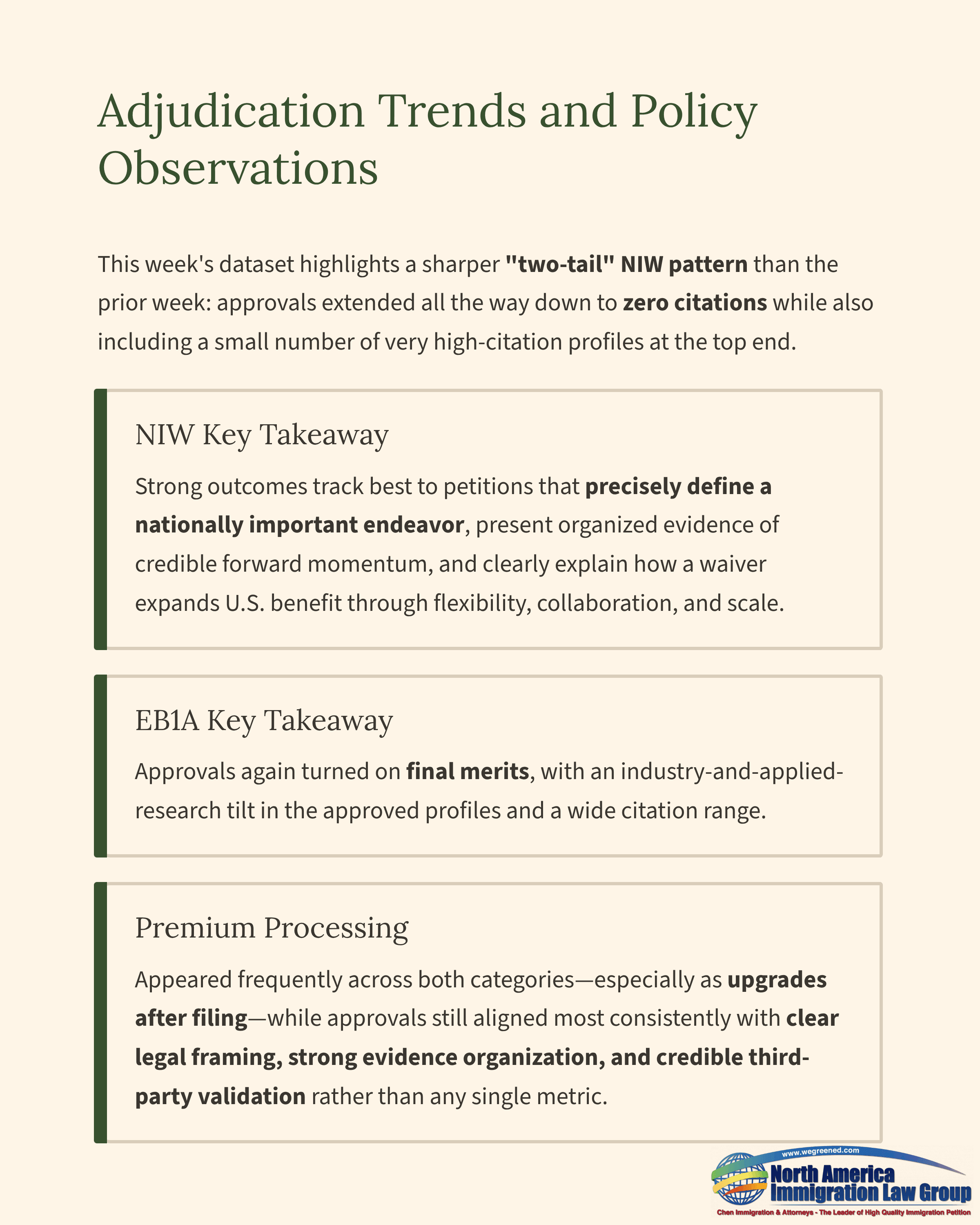
This week’s dataset highlights a sharper “two-tail” NIW pattern than the prior week: approvals extended all the way down to zero citations while also including a small number of very high-citation profiles at the top end. That spread reinforces the practical reality of NIW adjudication—strong outcomes track best to petitions that precisely define a nationally important endeavor, present organized evidence of credible forward momentum, and clearly explain how a waiver expands U.S. benefit through flexibility, collaboration, and scale.On EB1A, approvals again turned on final merits, with an industry-and-applied-research tilt in the approved profiles and a wide citation range. Across both categories, premium processing appeared frequently—especially as upgrades after filing—while approvals still aligned most consistently with clear legal framing, strong evidence organization, and credible third-party validation rather than any single metric.