
WeGreened Approval Statistics: Week of January 12, 2026
During the week of January 12 to January 18, 2026, WeGreened received 125 approval notices from U.S. Citizenship and Immigration Services (USCIS). Of the 125 approvals, 80 were for NIW (National Interest Waiver), 31 were for EB1A (Alien of Extraordinary Ability), 11 were for EB1B (Outstanding Professors or Researchers), and 3 were for O1A (Individuals with Extraordinary Ability or Achievement).
NIW again represented the majority of approvals, while EB1A remained strong among petitioners whose records could be presented as sustained, field-recognized excellence under a totality-of-the-evidence review.
EB1A and NIW Credential Analysis
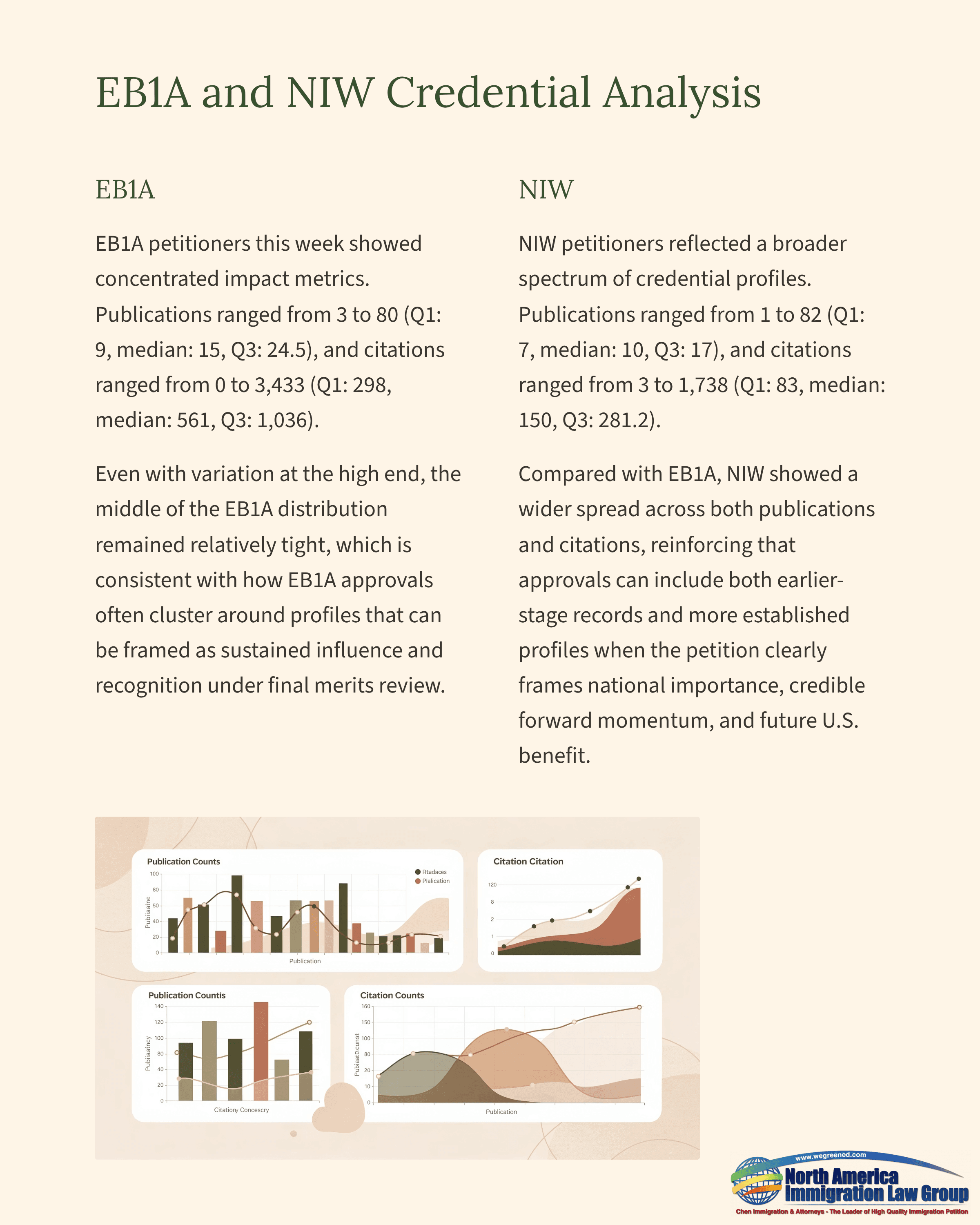
EB1A petitioners this week showed concentrated impact metrics. Publications ranged from 3 to 80 (Q1: 9, median: 15, Q3: 24.5), and citations ranged from 0 to 3,433 (Q1: 298, median: 561, Q3: 1,036). Even with variation at the high end, the middle of the EB1A distribution remained relatively tight, which is consistent with how EB1A approvals often cluster around profiles that can be framed as sustained influence and recognition under final merits review.NIW petitioners reflected a broader spectrum of credential profiles. Publications ranged from 1 to 82 (Q1: 7, median: 10, Q3: 17), and citations ranged from 3 to 1,738 (Q1: 83, median: 150, Q3: 281.2). Compared with EB1A, NIW showed a wider spread across both publications and citations, reinforcing that approvals can include both earlier-stage records and more established profiles when the petition clearly frames national importance, credible forward momentum, and future U.S. benefit.
Insights on Petitioner Backgrounds and Fields
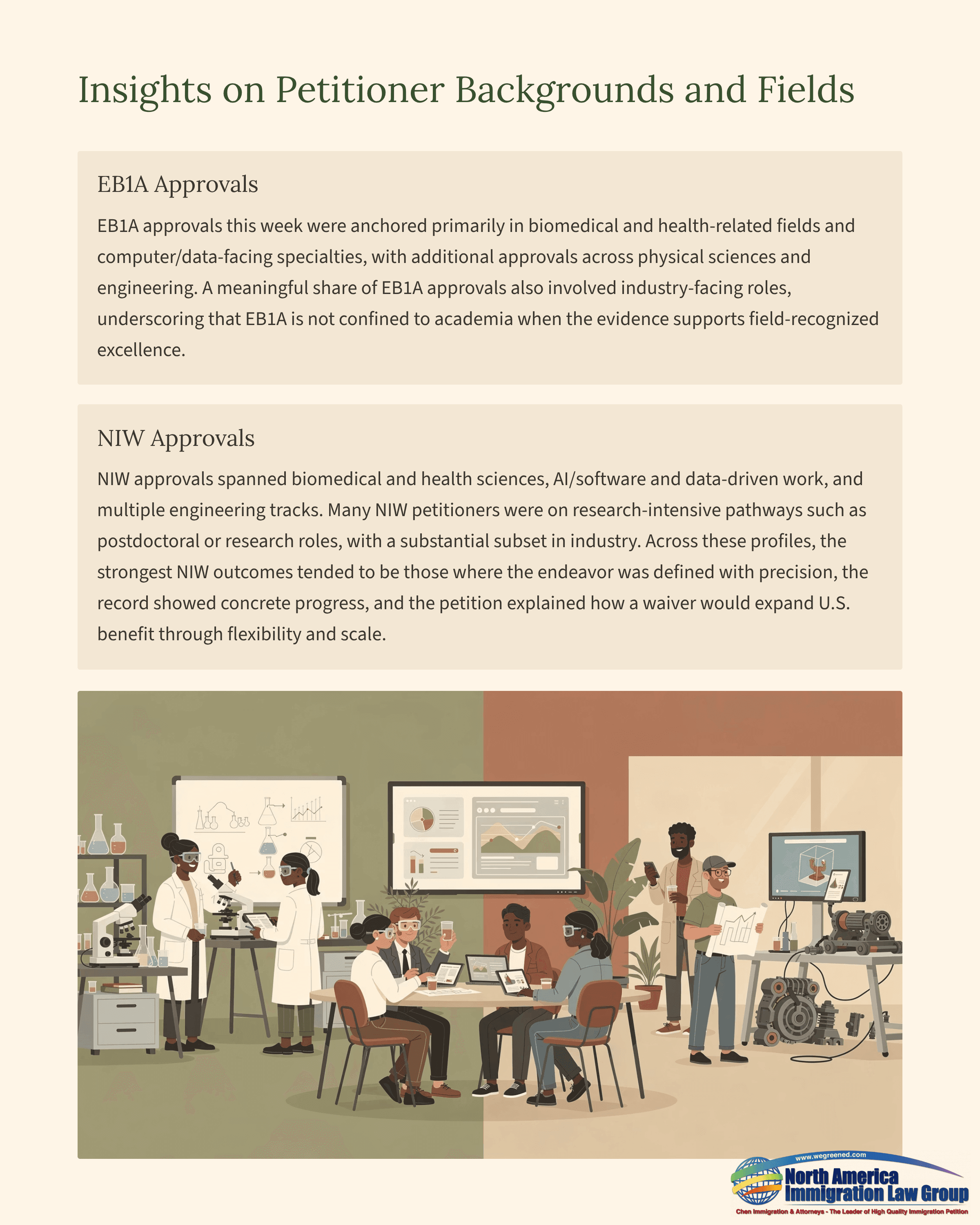
EB1A approvals this week were anchored primarily in biomedical and health-related fields and computer/data-facing specialties, with additional approvals across physical sciences and engineering. A meaningful share of EB1A approvals also involved industry-facing roles, underscoring that EB1A is not confined to academia when the evidence supports field-recognized excellence.NIW approvals spanned biomedical and health sciences, AI/software and data-driven work, and multiple engineering tracks. Many NIW petitioners were on research-intensive pathways such as postdoctoral or research roles, with a substantial subset in industry. Across these profiles, the strongest NIW outcomes tended to be those where the endeavor was defined with precision, the record showed concrete progress, and the petition explained how a waiver would expand U.S. benefit through flexibility and scale.
Highlighted EB1A Case: EB1A Approved in 18 Days for a FinTech VP With Zero Citations
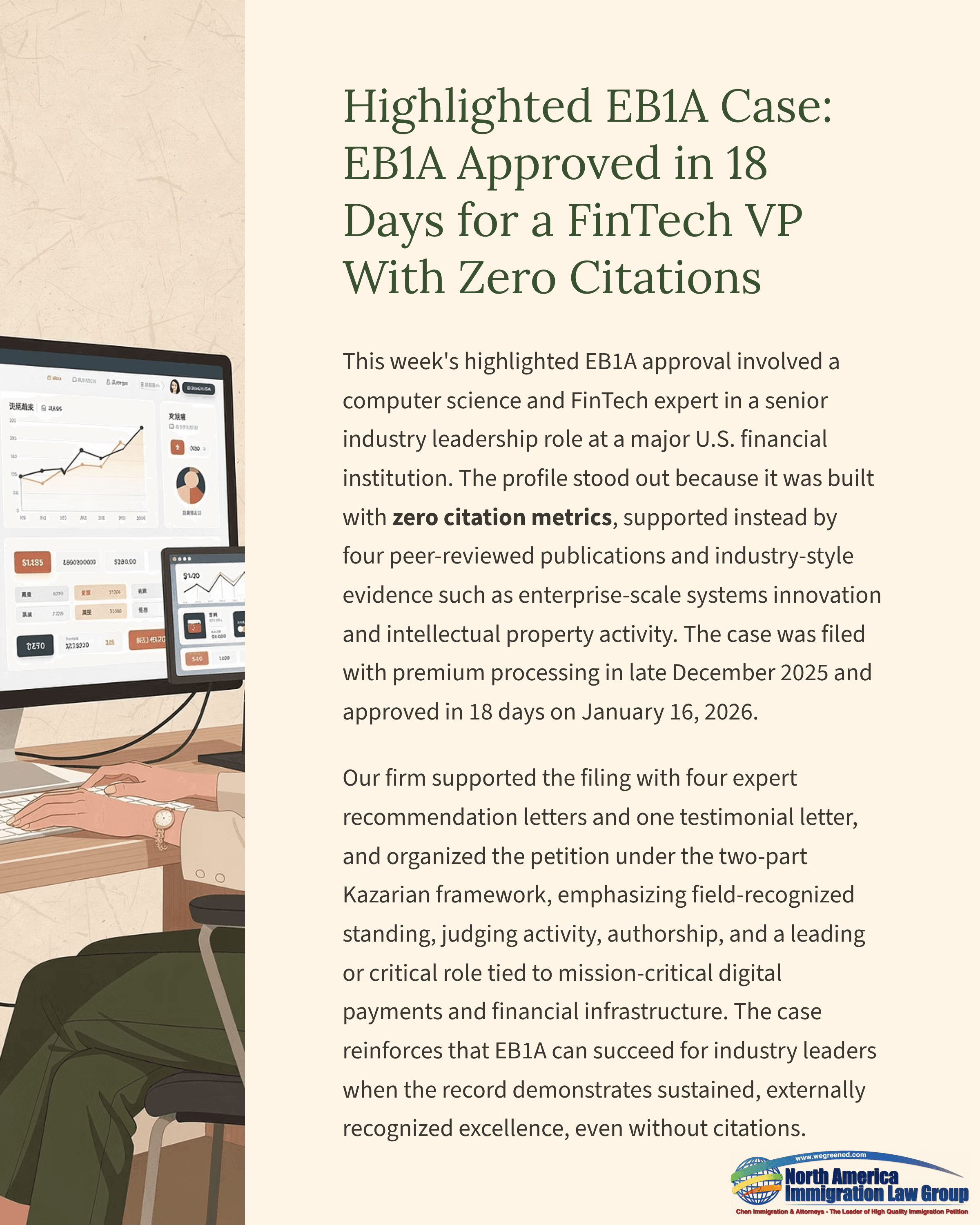
One notable EB1A approval this week involved a computer science and financial technology expert working in a senior, industry-facing leadership role as a vice president and lead software engineer at a major U.S. financial institution. What makes this case stand out is that the profile did not rely on citation metrics at all. The record included four peer-reviewed publications with zero citations, along with technical and professional contributions more typical of high-impact industry tracks, such as enterprise-scale systems innovation and intellectual property activity. The petition was filed with premium processing in late December 2025 and approved in 18 days (approval date: January 16, 2026). To strengthen third-party validation, our firm prepared four expert recommendation letters and one testimonial letter, designed to translate the petitioner’s real-world influence into evidence that fits EB1A’s legal framework.Strategically, we structured the filing under the two-part Kazarian approach and focused on evidence that USCIS officers can evaluate clearly even when academic metrics are not the core story. On the regulatory criteria side, we documented field-recognized standing through selective professional memberships (including senior-level recognition within major technical associations), sustained judging activity for respected technology and innovation awards and venues, and scholarly authorship paired with technical credibility. We also supported the leading or critical role element by tying the petitioner’s responsibilities to mission-critical work in digital payments and secure financial infrastructure at a distinguished organization. In the final merits analysis, we connected these criteria into a single narrative of sustained acclaim by showing how the petitioner’s work advanced real-time, high-reliability payment systems and strengthened large-scale validation frameworks that support security, scalability, and trust in U.S. financial technology.
This case is a useful reminder that EB1A is not limited to citation-driven academic profiles. When an industry leader’s influence can be documented through credible, objective indicators and reinforced by strong third-party validation, a well-organized petition can meet both the regulatory criteria and the final merits standard, even with zero citations.
Adjudication Trends and Policy Observations
EB1A approvals this week again turned on sustained acclaim and final merits, where meeting three criteria is only the threshold and the total record must add up to field-recognized excellence. A notable data point this week is that EB1A approvals included a zero-citation profile, reinforcing that officers can credit non-academic, field-appropriate proof when the evidence clearly demonstrates external recognition, critical roles, and consequential contributions that extend beyond internal job performance.NIW approvals continued to span diverse disciplines and career stages, with outcomes this week stretching across a very wide citation range, including approvals at the lowest end of the dataset. At the same time, the most common procedural pattern for NIW approvals was premium processing used as an upgrade after filing rather than an upfront request. The consistent throughline, however, remained unchanged: approvals tracked best to petitions that precisely defined a nationally important endeavor, organized concrete evidence to show the petitioner was well positioned, and clearly explained how a waiver would expand U.S. benefit through flexibility, collaboration, and scale.