
WeGreened Approval Statistics: Week of January 5, 2026
During the week of January 5 to January 11, 2026, WeGreened received 93 approval notices from U.S. Citizenship and Immigration Services (USCIS). Of the 93 approvals, 59 were for NIW (National Interest Waiver), 25 for EB1A (Alien of Extraordinary Ability), 7 for EB1B (Outstanding Professors or Researchers), and 2 for O1A (Individuals with Extraordinary Ability or Achievement).
NIW again represented the majority of approvals, while EB1A remained strong among petitioners whose records could be presented as sustained, field-recognized excellence under a totality-of-the-evidence review.
EB1A and NIW Credential Analysis
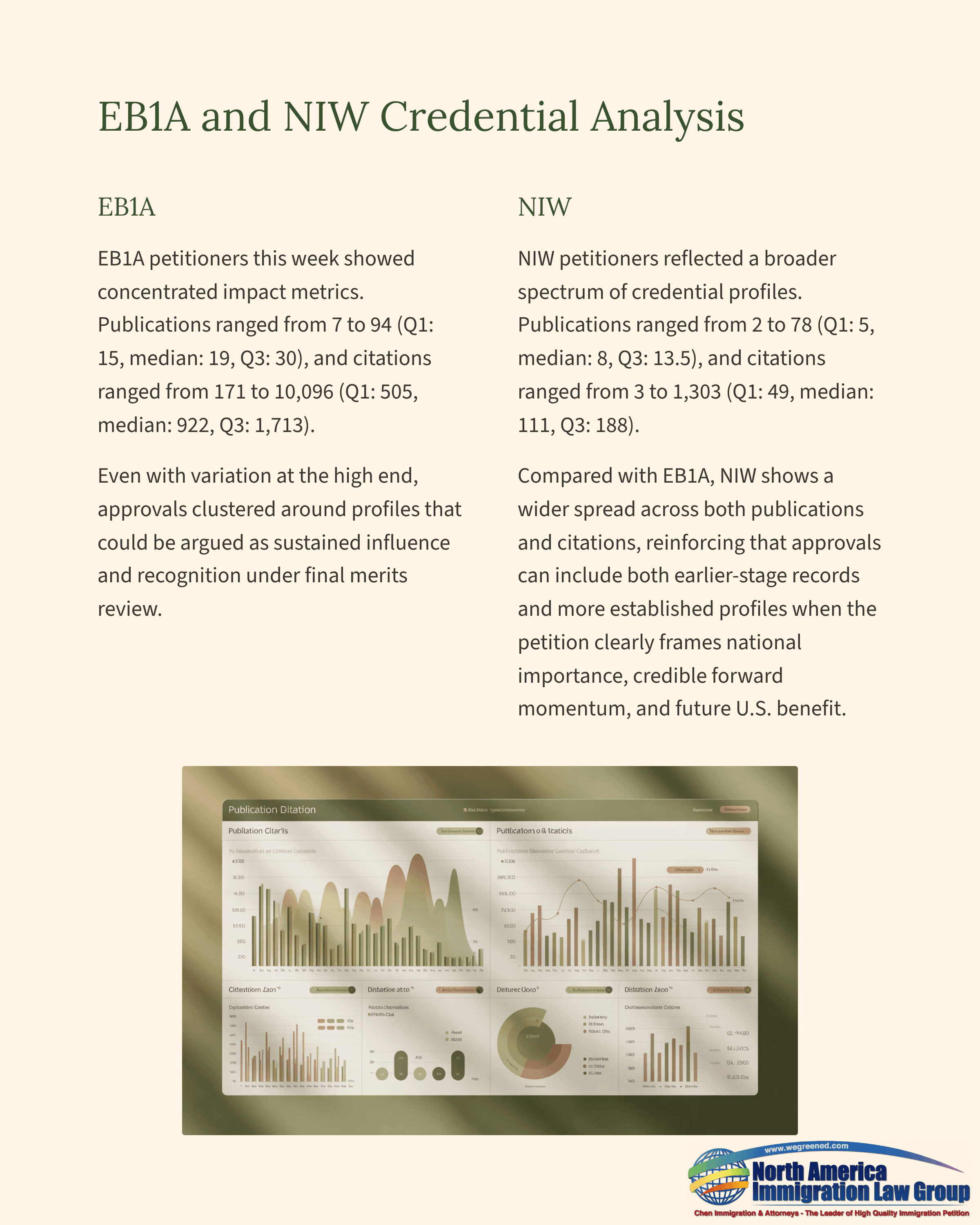
EB1A petitioners this week showed concentrated impact metrics. Publications ranged from 7 to 94 (Q1: 15, median: 19, Q3: 30), and citations ranged from 171 to 10,096 (Q1: 505, median: 922, Q3: 1,713). Even with variation at the high end, approvals clustered around profiles that could be argued as sustained influence and recognition under final merits review.NIW petitioners reflected a broader spectrum of credential profiles. Publications ranged from 2 to 78 (Q1: 5, median: 8, Q3: 13.5), and citations ranged from 3 to 1,303 (Q1: 49, median: 111, Q3: 188). Compared with EB1A, NIW shows a wider spread across both publications and citations, reinforcing that approvals can include both earlier-stage records and more established profiles when the petition clearly frames national importance, credible forward momentum, and future U.S. benefit.
Insights on Petitioner Backgrounds and Fields
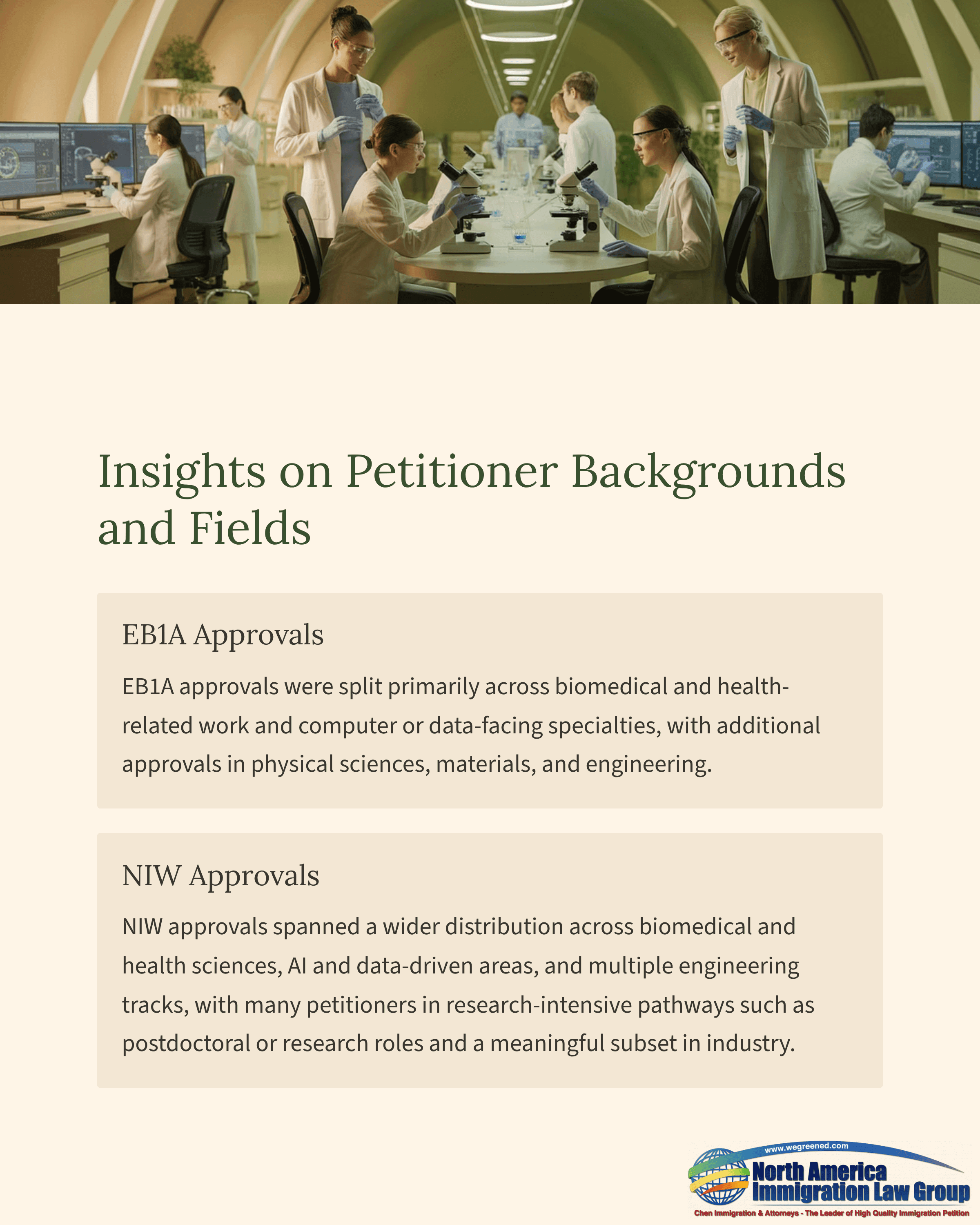
EB1A approvals were split primarily across biomedical and health-related work and computer or data-facing specialties, with additional approvals in physical sciences, materials, and engineering.NIW approvals spanned a wider distribution across biomedical and health sciences, AI and data-driven areas, and multiple engineering tracks, with many petitioners in research-intensive pathways such as postdoctoral or research roles and a meaningful subset in industry.
Highlighted NIW Case: NIW Approved With 3 Citations for an Industry Applied Scientist
One notable NIW approval this week involved a PhD-trained human–AI interaction researcher working as an applied scientist in industry. The petitioner’s work focuses on building human-centered AI frameworks that integrate behavioral science into AI and large language model design, helping improve how AI systems perform and how they are used in real-world settings. The record included 2 publications and 3 citations. The case was filed with premium processing on December 9, 2025, and approved on January 5, 2026, after 27 days of processing.From a strategy perspective, we built the petition to keep the officer’s review evidence-driven and easy to follow under the Dhanasar framework, even with a low citation total. We anchored the proposed endeavor in the practical need for trustworthy, human-centered AI systems, then highlighted field-appropriate indicators of influence beyond citations, including how the work is positioned for real-world adoption and measurable improvements in AI performance and reliability. To strengthen third-party validation, the case was supported by two expert recommendation letters, including one dependent recommender and one independent recommender, along with three testimonial letters that reinforced real-world relevance and corroborated the petitioner’s role and contributions in an applied setting. To strengthen the “well-positioned” showing, we organized the record around execution ability, implementation context, and a demonstrated capacity to advance the work in an industry environment. For the final prong, we explained why a waiver supports broader U.S. benefit by enabling flexibility and scale, allowing the petitioner to extend impact through collaboration and wider deployment rather than being limited to a single employer pathway.
This case reinforces that NIW outcomes are rarely decided by a single number. When the endeavor is defined precisely, the evidence is presented clearly under Dhanasar, and the record includes credible third-party validation, USCIS can approve even low-citation industry profiles.
Adjudication Trends and Policy Observations
EB1A approvals this week again reflected the familiar structure of adjudication. Meeting at least three criteria is necessary, but the decisive work happens in final merits, where the record must add up to sustained acclaim and field-recognized excellence under the totality of the evidence. This week’s EB1A outcomes also continued to include industry-facing roles, reinforcing that officers focus less on where the work occurs and more on whether the evidence demonstrates durable, external recognition.NIW approvals again covered a wide range of disciplines and career stages. In this batch, premium processing appeared more often as an upgrade after filing than as an upfront request, but the consistent throughline remained the same: approvals tracked best to petitions that clearly defined a nationally important endeavor, demonstrated the petitioner was well positioned with concrete, organized evidence, and explained how a waiver would expand U.S. benefit through flexibility, collaboration, and scale.