

WeGreened Weekly Approval Summary: Week of May 25, 2026
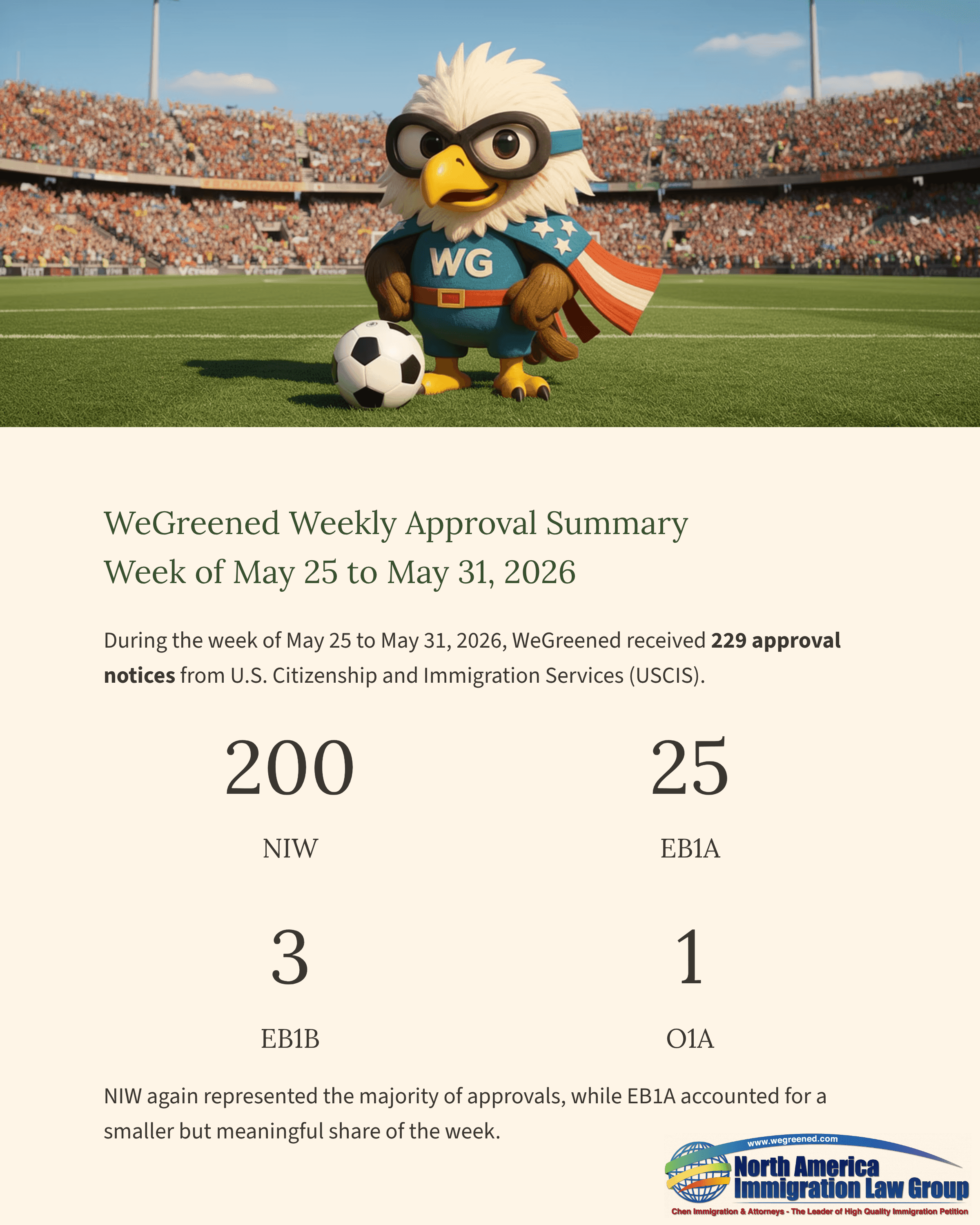
During the week of May 25 to May 31, 2026, WeGreened received 229 approval notices from U.S. Citizenship and Immigration Services (USCIS). Of the 229 approvals, 200 were for NIW (National Interest Waiver), 25 were for EB1A (Alien of Extraordinary Ability), 3 were for EB1B (Outstanding Professors or Researchers), and 1 was for O1A (Individuals with Extraordinary Ability or Achievement).
NIW again represented the majority of approvals, while EB1A accounted for a smaller but meaningful share of the week.
EB1A and NIW Credential Analysis
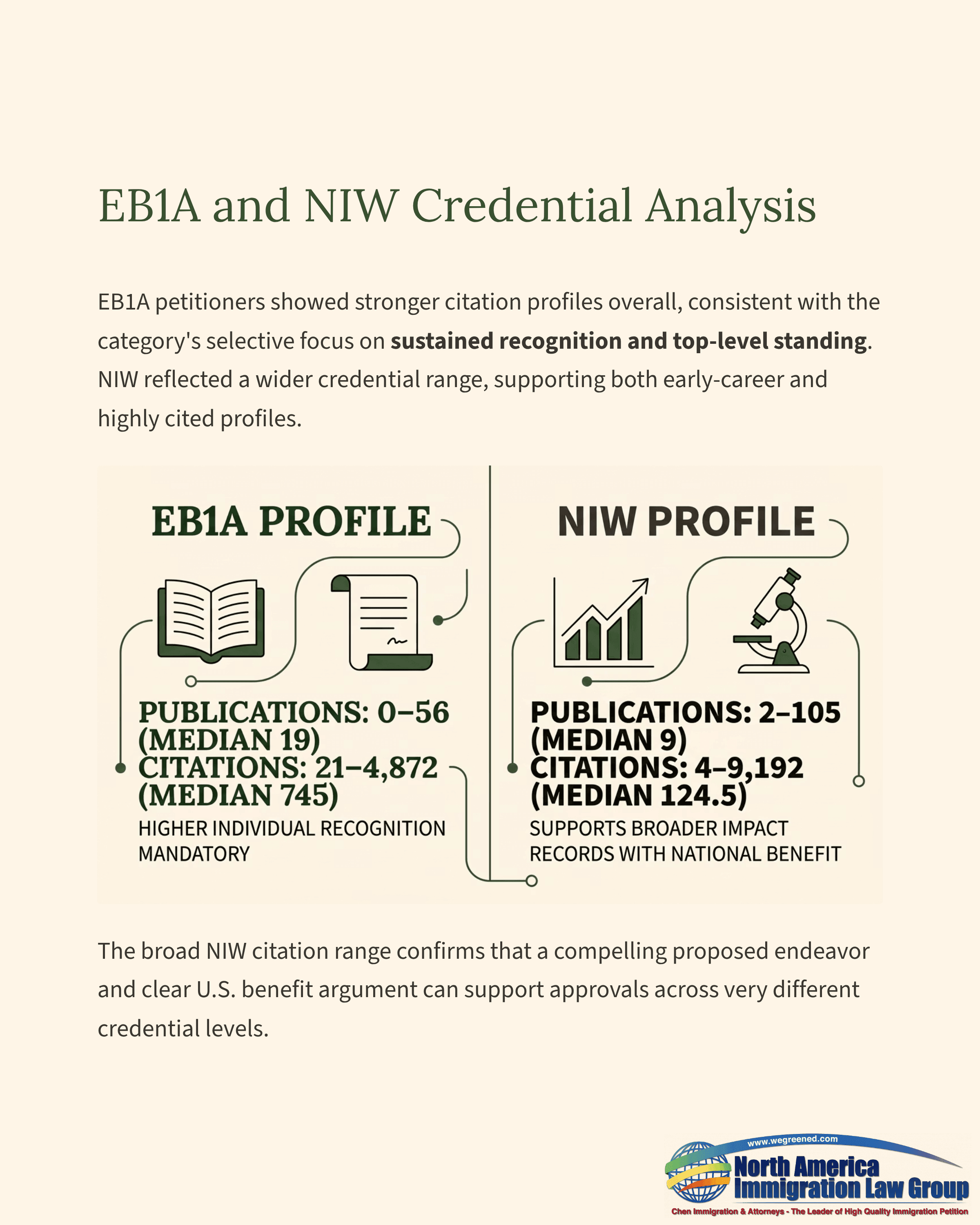
EB1A petitioners this week showed strong citation profiles overall, with one important low metric outlier. Publications ranged from 0 to 56 (Q1: 12, median: 19, Q3: 27), and citations ranged from 21 to 4,872 (Q1: 496, median: 745, Q3: 1,118). The median citation count was significantly higher than the NIW median, which is consistent with EB1A’s more selective focus on sustained recognition and top-level standing in the field.
NIW petitioners reflected a wider credential range. Publications ranged from 2 to 105 (Q1: 6, median: 9, Q3: 15), and citations ranged from 4 to 9,192 (Q1: 53.75, median: 124.5, Q3: 338). The broad range shows that NIW can support both earlier impact records and highly cited profiles when the application clearly explains the proposed endeavor, the applicant’s ability to advance it, and the expected U.S. benefit.
Insights on Petitioner Backgrounds and Fields
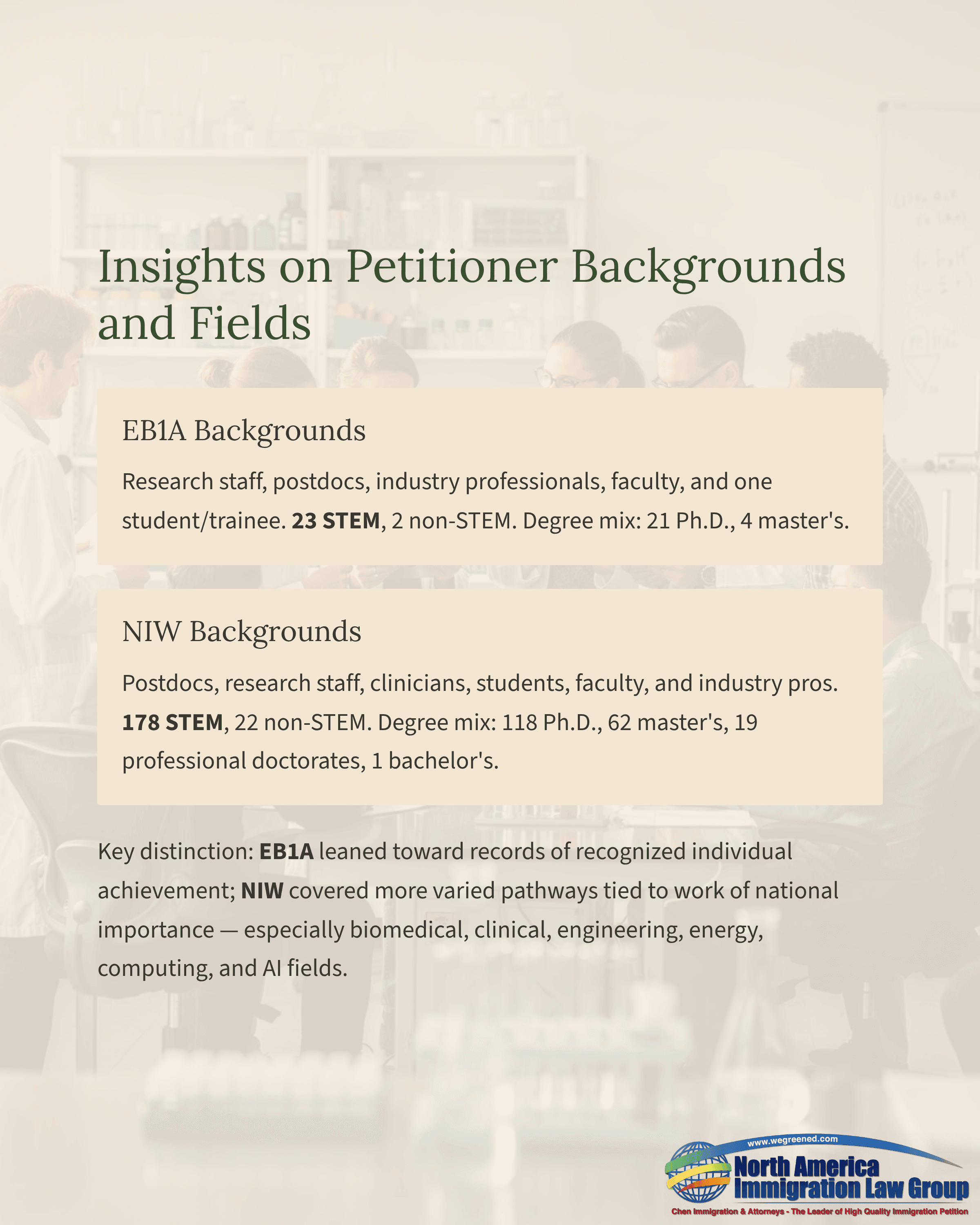
This week’s EB1A approvals were not limited to one career setting. The group included research staff, postdoctoral researchers, industry professionals, faculty members, and one student or trainee. The main takeaway is that EB1A strength came from evidence of individual recognition, not merely from job title. The category remained heavily STEM focused, with 23 STEM approvals and 2 non-STEM approvals, and the degree mix included 21 Ph.D. holders and 4 master’s level petitioners.
NIW approvals were broader in both career stage and field. Postdoctoral researchers and research staff formed the largest groups, but the approvals also included students or trainees, industry professionals, faculty members, clinicians, and one other professional. Field coverage was especially strong in biomedical, clinical, and public health areas, followed closely by engineering, energy, materials, computing, data, and AI. NIW also remained STEM-centered, with 178 STEM approvals and 22 non-STEM approvals. The degree mix included 118 Ph.D. holders, 62 master’s level petitioners, 19 professional doctorate holders, and 1 bachelor’s or exceptional ability filing without an advanced degree.
Together, these results show a practical distinction. EB1A cases leaned toward records that could demonstrate recognized individual achievement, while NIW cases covered more varied professional pathways tied to work of national importance.
Highlighted EB1A Case: Approved Without Publications for a Machine Learning and Data Engineering Professional
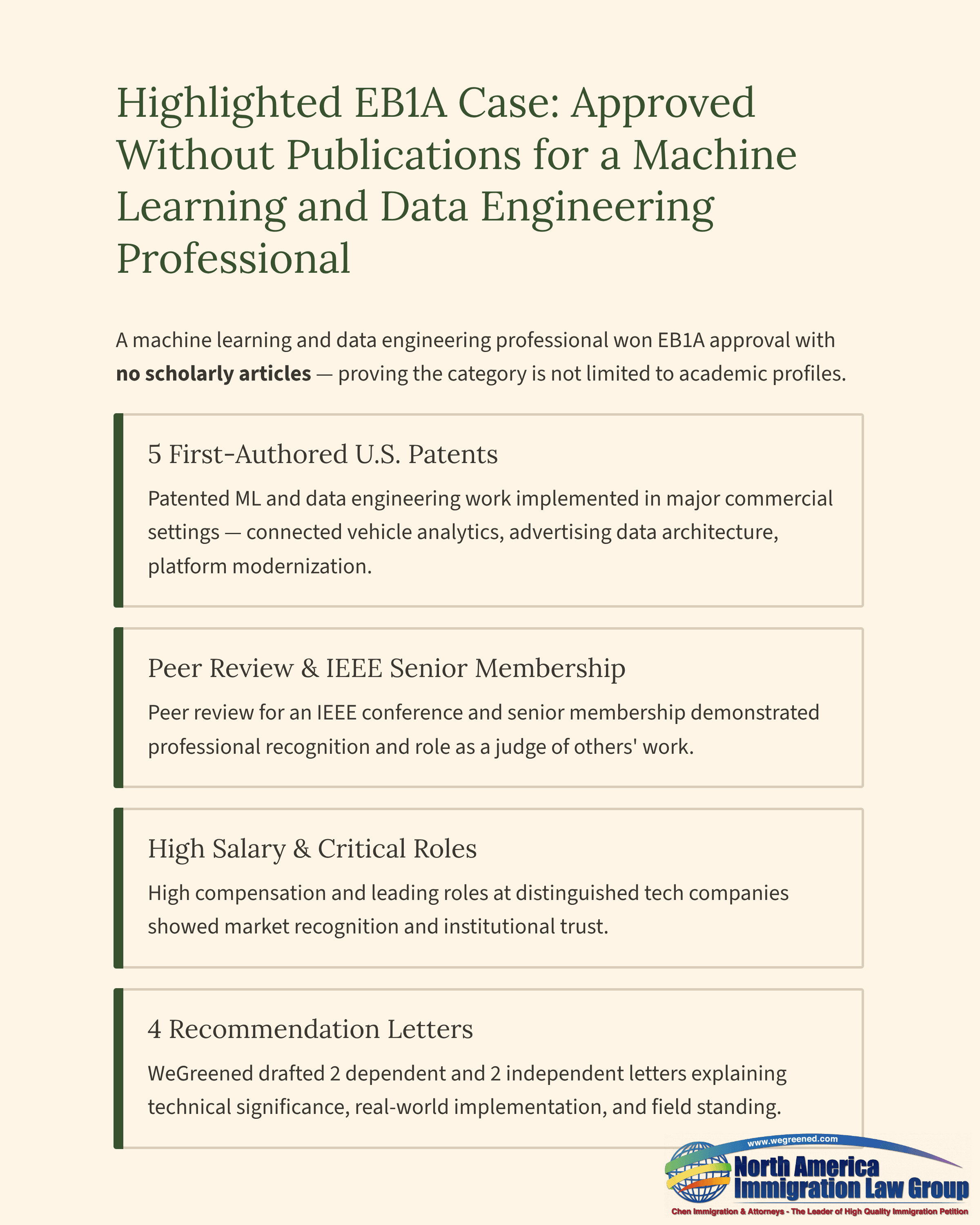
One of the most instructive EB1A approvals this week involved a machine learning and data engineering professional who had no publications, but whose U.S. patents had received 21 citations at the time of filing. Instead of relying on traditional scholarly articles, the application emphasized five first-authored U.S. patents, peer review service for an IEEE conference, IEEE senior membership, high salary evidence, and leading or critical roles at distinguished technology companies.
Our strategy centered on translating industry impact into EB1A evidence. For original contributions of major significance, the application focused on patented machine learning and data engineering work that had been implemented in major commercial settings. The record showed impact through concrete use cases, including connected vehicle analytics, employer advertising data architecture, and data platform modernization. This helped demonstrate that the work was not merely internal technical support, but innovation with measurable value to organizations and users.
The application also strengthened the final merits by showing through multiple evidence categories. Peer review supported the petitioner’s role as a judge of others’ work. High compensation helped show market recognition. Leading and critical roles showed institutional trust at respected companies. Senior membership in IEEE added another indicator of professional recognition. Our firm also drafted 2 dependent and 2 independent recommendation letters, which helped explain the technical significance of the patents, the real-world implementation of the work, and the petitioner’s standing in the field.
This approval is a strong reminder that EB1A is not limited to traditional academic profiles. For industry applicants, patents, product implementation, business impact, technical leadership, peer validation, and carefully drafted recommendation letters can be powerful evidence when they are organized into a coherent final merits story.
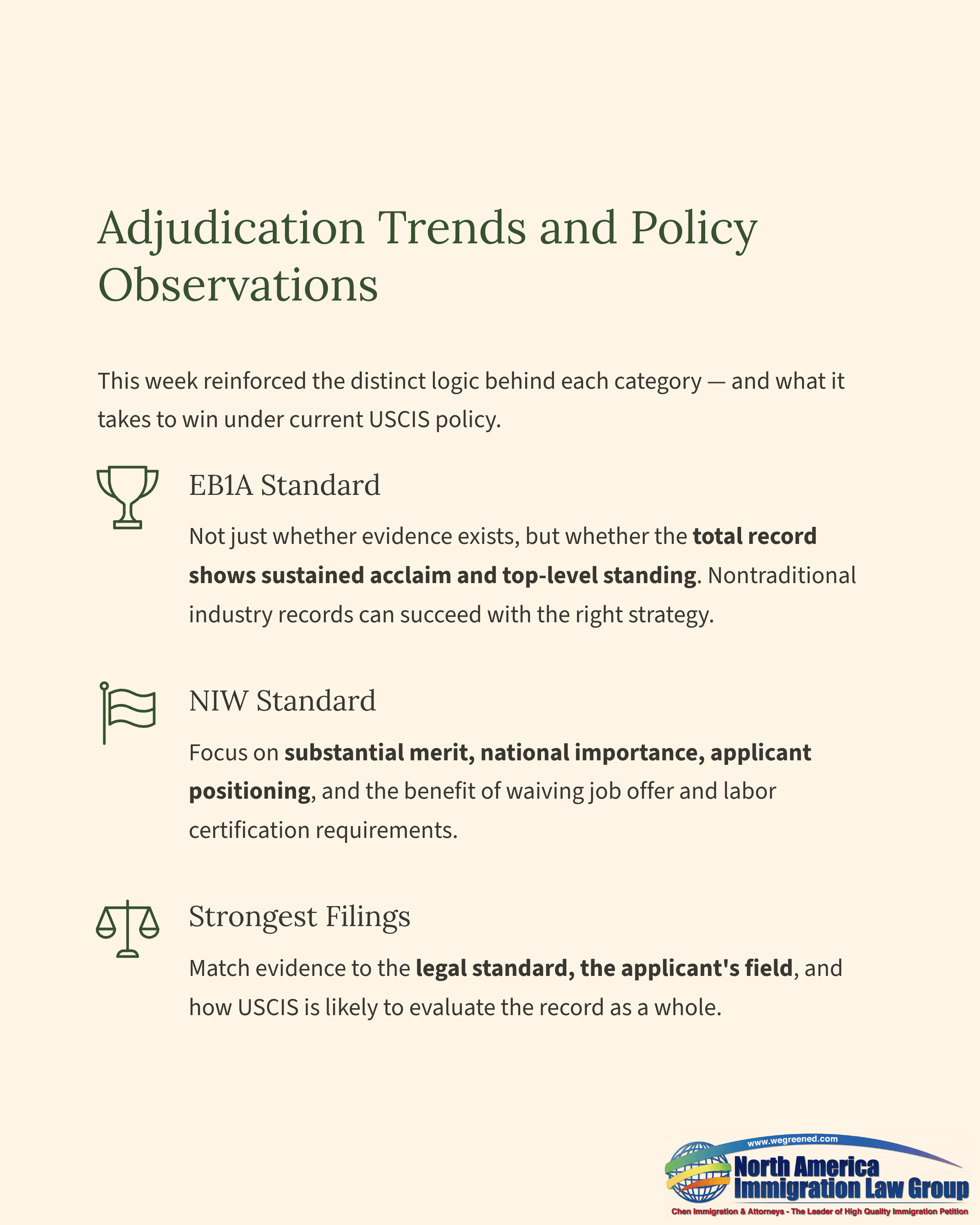
Adjudication Trends and Policy Observations
This week’s approvals again show the different logic of EB1A and NIW. EB1A remained more selective, but the highlighted approval shows that a nontraditional industry record can succeed when the evidence demonstrates original contributions, trusted roles, recognized expertise, and sustained influence in the field.
NIW continued to support a wider range of career stages and credential levels when the application clearly connected the proposed work to a national need. In current USCIS policy terms, NIW remains focused on substantial merit, national importance, whether the applicant is well-positioned, and whether a waiver would benefit the United States overall.
Current USCIS guidance continues to support this practical approach. For EB1A, the focus is not simply whether evidence exists, but whether the total record shows sustained acclaim and top-level standing. For NIW, the focus remains on the proposed endeavor, the applicant’s positioning, and the benefit of waiving the job offer and labor certification requirements. Across both categories, the strongest filings match the evidence to the legal standard, the applicant’s field, and the way USCIS is likely to evaluate the record as a whole.